KEY TAKEAWAYS
- A well-designed, properly built garden room typically adds 5–15% to a property’s value — on a £300,000 home, that’s up to £45,000.
- Quality and specification are the difference between a value-add and a liability — a poorly built garden room can actually put buyers off.
- Garden rooms in Scotland typically offer better ROI than kitchen renovations and are comparable to loft conversions, at significantly lower cost and disruption.
- The Scottish building warrant process and planning rules must be correctly followed for the room to count as a compliant, marketable asset when you sell.
- Hybrid working has made dedicated garden offices one of the most actively sought-after features for buyers in the current Scottish property market.
It’s one of the most common questions we hear before a project starts: “will this actually add value to my home?” It’s a fair question. A garden room is a significant investment, and it’s natural to want to know whether you’re improving your property or simply spending money on something you’ll enjoy but won’t recoup.
The short answer is that a quality garden room does add value — consistently and meaningfully, when it’s built to the right specification. The longer answer is that the difference between a room that adds value and one that doesn’t comes down almost entirely to how it was built, not simply whether it exists.
What the Numbers Say
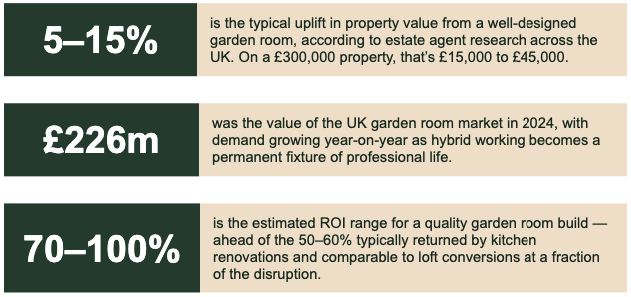
These figures reflect the current reality of the UK property market, where dedicated workspace and additional usable square footage have moved from nice-to-have to actively sought-after. According to the ONS, 28% of UK working adults were hybrid workers in the first quarter of 2025 — and that proportion continues to grow. Buyers who work from home, even part of the week, now factor the presence of a proper garden office directly into their purchasing decisions in a way that simply wasn’t the case five years ago.
What Makes the Difference Between Value-Add and Liability
Not all garden rooms increase your property’s value. Estate agents and buyers are increasingly sophisticated about what they’re looking at, and a poorly built garden room — a thin-walled kit with a damp floor and a ropey electrical connection — can actually put buyers off rather than attract them. Here’s what separates a room that adds value from one that doesn’t.
Specification and Build Quality
A properly insulated, weathertight structure with a solid concrete base, pressure-treated timber throughout, and a well-detailed roof reads to a buyer as a permanent, usable asset. A kit-built room with inadequate insulation, signs of movement or damp, and thin cladding reads as something that will need replacing — a cost, not an asset. The quality of the build is visible to anyone who spends two minutes looking at it, and estate agents price accordingly.
Year-Round Usability
A garden room that’s usable in January in Dumfries and Galloway — where a cold winter morning is a different proposition from the south of England — is worth considerably more than one that functions only in summer. Insulated walls, roof, and floor, combined with a reliable heat source and double-glazed windows, are the difference between a workspace and a garden shed with pretensions. For buyers in Scotland, year-round usability is a genuine practical need rather than a luxury.
Electrics Done Properly
Lighting, heating, and multiple sockets are now expected in any garden room presented to buyers as a usable workspace. More importantly, the electrical installation needs to be done correctly — by a registered electrician, with the appropriate certification — because buyers’ solicitors increasingly ask for this documentation. A garden room with DIY electrics and no paperwork creates a problem at the point of sale, not an asset.
Planning and Building Warrant Compliance
In Scotland, this is the step that most buyers’ solicitors will specifically ask about. If a garden room required a building warrant — and most rooms with electrics, a concrete base, or significant structural elements do — and one was never obtained, it creates a legal issue at the point of sale. A room that was built correctly, with the right permissions in place, is a marketable asset. One that wasn’t is a liability that may need to be disclosed, altered, or removed. This is one of the reasons we handle the planning and warrant process with every client from the outset.
Design That Complements the Property
A garden room that looks like it belongs to the house — in its materials, proportions, and finish — adds visual appeal as well as functional space. A room that looks like it arrived on a lorry and was bolted to the garden without any thought about the surroundings does neither. In Dumfries and Galloway, where stone-built houses and traditional architecture are common, a timber garden room with appropriate cladding, a pitched roof, and a considered finish integrates naturally. A white plastic-trimmed flat-pack doesn’t.
Is the Picture Different in Scotland?
In some respects, yes. The Scottish property market moves at a different pace from London and the South East, and the headline value increases cited in some UK-wide guides are partly driven by activity in high-demand urban markets. In Dumfries and Galloway — a rural and semi-rural market — the value uplift from a garden room is real but should be thought of more conservatively than national averages suggest.
What doesn’t change is the appeal. Buyers in Castle Douglas, Dumfries, Kirkcudbright, and surrounding areas are looking for the same things as buyers elsewhere: space that works, buildings that last, and properties that don’t come with hidden problems. A garden room that’s been built properly, insulated for a Scottish winter, and fully compliant with local planning and building warrant requirements will appeal to the same professional buyers who are driving demand nationally.
It’s also worth noting that in a market where many properties don’t have a garden room, the presence of one creates genuine differentiation at the point of sale. A buyer choosing between two similar properties, one with a fully insulated home office in the garden and one without, will almost always factor that into their offer.
How to Get the Most Value From Your Garden Room
- Build to a full specification from the start. Insulation, electrics, and a solid base are not optional extras if value is a goal — they’re the foundation of it.
- Think about the design in the context of the whole property. A room that looks like it was designed for your garden, not dropped into it, will be valued more highly by buyers.
- Get the building warrant and any planning documentation in order before the build starts, not after. Retrofitting compliance is significantly more difficult and expensive than doing it correctly from day one.
- Keep a record of the build: who built it, when, what specification, and what electrical certificates were issued. This documentation matters at the point of sale.
- Consider function when planning the interior. A room fitted out as a usable home office — with proper lighting, heating, and connectivity — is easier for a buyer to value than a bare shell they’d have to fit out themselves.
What Signature Woodwork Builds
Every garden room we build in Castle Douglas and across Dumfries and Galloway is designed from the ground up for the Scottish climate and the specific property it’s going on. We use pressure-treated structural timber throughout, specify insulation appropriate for year-round use, and work through the building warrant process from the start so the room is fully compliant when it’s finished.
If you’re thinking about a garden room as an investment in your property as well as your lifestyle, it’s worth starting the conversation before you’ve made any decisions about size or specification. Get in touch to arrange a free site visit and consultation.
Frequently Asked Questions
How much value does a garden room add in Scotland specifically?
The UK-wide figure of 5–15% is the established range from estate agent data, though the actual uplift in a rural or semi-rural Scottish market like Dumfries and Galloway will depend on local comparable properties and buyer demand. The more useful framing is often ROI: a quality garden room costing £20,000–25,000 that adds £15,000–25,000 to the sale price of a £250,000 property represents a strong return, particularly when the enjoyment of the space in the years before sale is factored in.
Does a garden room need planning permission to count as a legal addition to the property?
Not necessarily — most fall under permitted development in Scotland and don’t need a planning application. However, a building warrant is typically required for any room with electrics, a concrete base, or significant structural elements, and this needs to be in place for the room to be marketed cleanly as a compliant addition at the point of sale. We handle this process with every build.
Will a poor-quality garden room reduce my property’s value?
It can. Estate agents note that a garden room in poor condition — showing signs of damp, inadequate insulation, or DIY electrics without certification — can create doubt in buyers’ minds and may actually be a negative on a viewing. A buyer who sees something they’d need to replace doesn’t see an asset; they see a future cost. Quality of build matters more than the presence of a building.
Is a garden room a better investment than a kitchen renovation?
In most cases, yes, on a pure ROI basis. A kitchen renovation typically returns 50–60% of its cost in added value. A quality garden room returns 70–100% or more, with the additional advantage of adding genuinely new, usable square footage rather than upgrading existing space. The disruption is also considerably lower — a garden room build typically doesn’t affect daily life in the main house the way a kitchen refit does.
Does it matter what the garden room is used for, in terms of value?
Yes, to an extent. A home office is currently the most universally appealing use case, given hybrid working habits, and tends to be valued most positively by buyers. A hobby room, gym, or studio is valued on the quality of the build rather than the specific use, since buyers can repurpose it. A room set up as a self-contained annexe or separate dwelling has different planning and building warrant implications and may be valued differently again.
Conclusion
A garden room is one of the few home improvements that can genuinely return more than it costs — in added property value, in day-to-day quality of life, and in the appeal it creates for buyers when you come to sell. The key is building it properly: to a full specification, from compliant materials, with the right permissions in place, and in a design that belongs to the property rather than sitting awkwardly beside it.
In Dumfries and Galloway, that’s exactly what Signature Woodwork builds. If you’d like to talk through what’s possible for your property, we’re happy to start with a free site visit, no obligation.
